

A Quick Hitch Bracket, also known as a Quick Coupler, is a device attached to the loader arm of a machine, such as a loader or excavator, that allows for rapid attachment and detachment of buckets, forks, and other attachments. The purpose of a Quick Hitch Bracket is to improve the efficiency and safety of attachment changes.
Before the invention of Quick Hitch Brackets, changing attachments on a loader or excavator required the operator to manually disconnect and reconnect hydraulic hoses and mechanical connections, which was time-consuming and often involved the use of tools. Quick Hitch Brackets eliminate the need for manual connection and disconnection, which saves time and reduces the risk of accidents and injuries.
With a Quick Hitch Bracket, the operator can change attachments quickly and easily from the safety of the cab, using only the loader’s hydraulic controls. This improves efficiency by reducing downtime and allows operators to switch between different attachments for different tasks, such as moving soil, loading rocks, or lifting pallets.
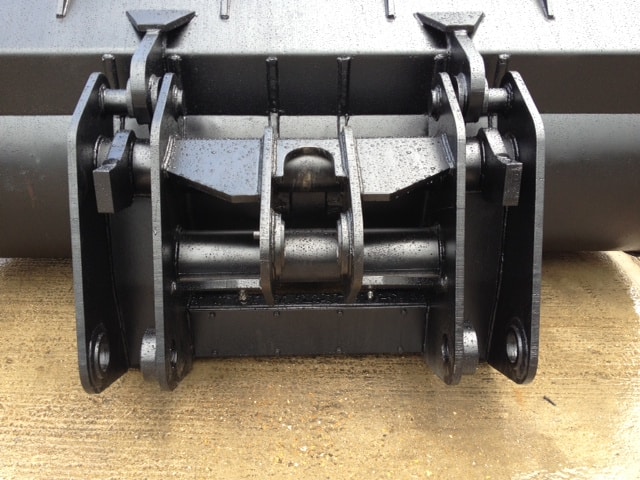
Quick Hitch Brackets are available in a range of sizes and types to fit different machines and attachments, and they are designed to meet safety standards set by regulatory agencies. When using a Quick Hitch Bracket, operators should follow the manufacturer’s instructions and recommended safety practices to prevent accidents and ensure proper operation.
Quick hitch fitting (QHF) on a piece of plant is a latching device that enables attachments to be connected to the plant and interchanged quickly. Depending upon the environment and application an operator may change the bucket and loading shovel attachments on his plant many times a day in order to maximise the machine productivity. and do specific tasks efficiently.
All quick hitches have to engage with the pins or lugs in the attachment and then retain the engagement with a latching mechanism which must then be secured to ensure that inadvertent disconnection does not occur. It is always recommended that the operator performs a visual check to ensure that the attachment is connected and the pins are securely located.
It is critical that the bucket doesn’t become unintentionally detached from a QHF which could be a potentially dangerous occurrence. In this article we look at some quick hitch brackets usage hints and tips
Types of Quick Hitch
Originally buckets and other attachments were secured to the end of the plant by bucket pins held in place by lynch pins or nuts and bolts. Problems with this method included
- To remove a bucket the pivot pins had to be withdrawn by hand, which could often be a time consuming procedure
- With wear and rust pins could be difficult to remove which presented the the consequent risk of hand and eye injuries to persons knocking
out the pins.
Buckets often need to be changed during the working day so to meet the needs of construction and agricultural processes quick hitches were
developed to speed up the process and reduce changeover time.
Depending on their method of operation Quick Hitches are further categorised
Manual Quick Hitches
Manual quick hitch systems require the operator to manually operate the latching mechanism. Once the bucket ( loading shovel attachment) is connected the latching mechanism should be locked (e.g. a safety pin inserted manually) to prevent inadvertent disconnection.
Whilst a manual quick hitch is faster than changing a direct attachment which is directly connected to the plant, it requires the operator to get down from the machine cab ( which is time consuming) and relies on the operator to install the locking device.
Fully Automatic Quick Hitches
Some of these systems have an indicator on the quick hitch so an operator can verify from the cab that the locking system has fully engaged.
Important
- The fully automatic quick hitch enables attachments to be changed very quickly.
- It is essential that these quick hitches are regularly inspected and maintained to ensure that damage, wear, or the ingress of foreign bodies does not prevent the locking mechanism from functioning correctly.
- From a safety perspective it is essential that operators get out of the cab to physically ensure that all quick hitches are securely locked before starting work with a newly attached attachment.
3 Simple Visual / Operational Checks
- Check that the locking pins are greased and move freely
- Are there any obvious missing or broken parts
- Check that Hydraulic pipes close to the hitch are not kinked, worn or badly damaged.
Quick Hitch Operator Checks
- Have operators been trained in the use of their Quick Hitch bracket
- Is there a checklist in the cab of daily and weekly inspection and maintenance carried out on the plant
- What are their management systems for checking whether manual safety pins are always in place?
- Are the safety pins inserted where appropriate
- Does the operator know how to visually check that the QH is locked?
- Does the operator know that, for all types of QH, they should test the security of the bucket after changing it?

Please call 01440 706429

Key Technical Considerations
- Compatible JCB models
- Bracket or quick hitch type
- Bucket width
- Hydraulic connection specification
- Recommended machine operating weight
Why does it matter?
Ensures the bucket has the correct carriage, pin centres or quick hitch arrangement.
Confirms the hydraulic hose connections, tipping geometry and machine lifting capacity are suitable.
Prevents expensive modifications after purchase.
Verifies the bucket is fully compatible with your JCB loader before purchase.
Key Technical Considerations
- Inspection report
- Condition of pivot pins and bushes
- Ram mounting integrity
- Weld inspection
- Wear on cutting edge and floor
- Evidence of previous repairs
Why does it matter?
A structural inspection helps identify fatigue, worn components or previous repairs that may affect long-term reliability.
Checking pivot points, welds and wear areas helps prevent unexpected failures and costly downtime.
Provides confidence that the bucket remains structurally sound and ready for service.
Key Technical Considerations
- Cylinder condition
- Ram seals checked
- Hose condition
- Pivot lubrication
- Full tipping cycle tested
- No excessive movement or backlash
Why does it matter?
Hydraulic components are often the most expensive wear items.
Worn cylinders can reduce tipping performance and leak under pressure.
Smooth operation is essential for maintaining productivity and reliability.
Confirms the hydraulic tipping system operates safely and efficiently.
Key Technical Considerations
- Water level capacity
- Heaped capacity
- Suitable materials (grain, woodchip, compost, light waste, aggregates, etc.)
- Approximate payloads for common materials
- Maximum recommended material density
Why does it matter?
Capacity alone does not determine suitability.
Material density has a significant effect on safe operating loads.
Matching the bucket to the intended application maximises productivity while protecting the machine.
Ensures the attachment is correctly specified for your materials and operating conditions.
Key Technical Considerations
- Service history
- Pins and bushes replaced
- Hydraulic seals replaced
- New cutting edge fitted (if applicable)
- Greasing schedule
- Availability of spare parts
Why does it matter?
A documented maintenance history provides a clear indication of how the bucket has been cared for.
Readily available replacement parts help minimise downtime and reduce future ownership costs.
Improves buyer confidence and supports long-term, cost-effective ownership.
