

What makes a world class high tip bucket?
There are a number of factors that are required for a high tip bucket to be considered world class. In this article we look at what we believe are 5 important elements to consider.
1: Great Design that Meets the Needs of the User
A high tip bucket should be designed specifically for the loads to be transported and the loader or tele-handler that you use. By focusing on the material to be moved, the loader and the height of reach required, allows a high tip bucket to be designed that will provide maximum efficiency.
The design team will discuss your needs and using CAD systems design the bucket so that you can see a scaled visual representation with dimensions. Having designers who have manufacturing experience as well as a comprehensive understanding of operating high tip buckets allows them to make important design choices. Such as
- What material thicknesses will be required to provide the correct balance between strength, weight and durability
- Depending on the operating environment would an auto lubrication system provide operational benefits
- Would you benefit from removable wear parts ( heel plates, wear edges etc) to enable the bucket to be easily refurbished
- Would your bucket benefit from a clear floor design allowing any substrates within the bucket to be easily emptied, with reduced chance of any residue remaining within the bucket

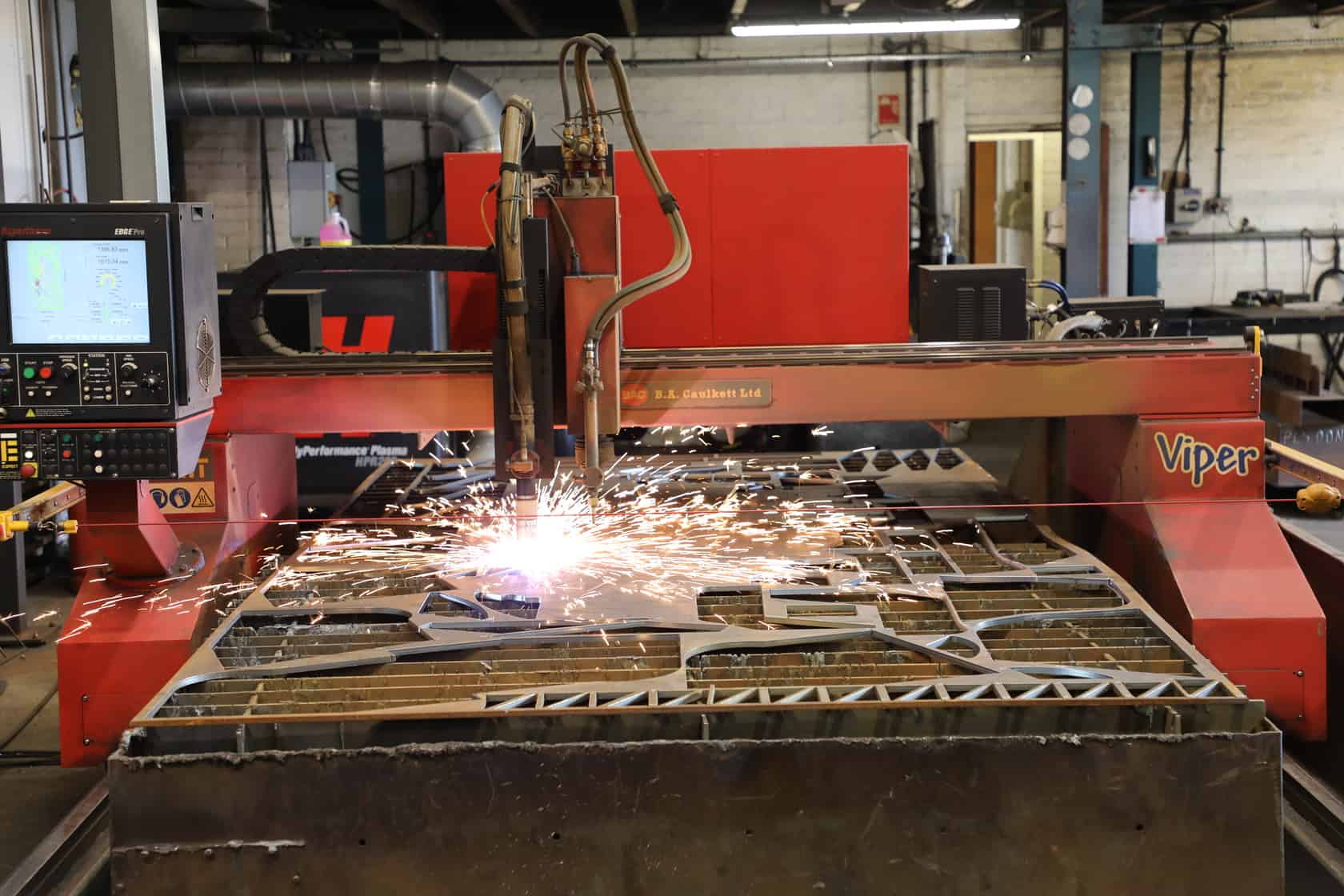
In House Manufacturing Capabilities
High Capacity Heavy Duty High Tip Buckets are sizeable items of plant. It is therefore very important that they are built on a single site, allowing all fabrication and assembly to be completed in a highly efficient manner, minimising any transportation / movement.
Separate areas with the production facility should exist for cutting of materials, welding and fabrication, spray painting and importantly final assembly and testing.
Modern, well illuminated (with modern LED Lighting) production areas with highly efficient extraction systems will provide an environment for effective production. B. A. Caulkett have invested in new facilities to provide a new dedicated fabrication area and specialist spraying facilities.
Individual Build and Attention To Detail
By assigning an individual engineer to be with a custom specification High Tip Bucket allows the engineer to takes responsibility for the build quality and ensuring that the bucket is completed on time.
B. A. Caulkett engineers take a huge amount of pride in their bucket fabrication. This shows through the quality of welds, the standard of finishing achieved and the durability of the buckets and there reliability in operation.


In House Painting Capabilities
We all know that High Tip Buckets will get scraped and bumped in operation but that’s no reason for them not to look great when they are manufactured. High Tip Buckets dont have to be in “Henry Ford” Black or Battleship Grey at B. A. Caulkett we will spray paint your bucket to whatever colour you want. Simply let us know the RAL code.
B. A. Caulkett have a dedicated spraying facility onsite which is capable of accommodating the largest of high tip buckets ( or any loading shovel attachments including pushers). With highly experienced spray painters a high quality paint finish can be achieved whatever the colour.
Testing & Operation
The last thing you want when your High Tip Bucket arrives is for it not to work , or suffer leaks when you fit it too your loader. All B. A. Caulkett high tip buckets are factory tested and adjusted to ensure that they can be simply connected to your loader and be immediately ready for operation.
High tip buckets are often used in “harsh” environments and worked hard. If damage occurs it is important that spare parts are readily available. B. A. Caulkett design their high tip buckets to have easily replaceable “wear parts”. With UK in house manufacturing items such as pins and bushes are all available from stock. Where required BAC service engineers can visit your site and complete repairs.

Please call 01440 706429
A premium high tip bucket is typically manufactured through five key stages.
Engineering Design and Finite Element Analysis (FEA)
- CAD modelling and load simulations
- Optimisation of stress distribution
- Calculation of tip geometry, breakout forces and centre of gravity
Material Selection
- Choosing the correct structural and wear-resistant steels
- Selecting appropriate steel thicknesses for each component
- Matching material specification to the intended application
Precision Fabrication and Welding
- CNC plasma or laser cutting
- Jig-built fabrication for dimensional accuracy
- Qualified welding procedures to minimise distortion
Hydraulic System Installation
- Correct ram sizing
- Hydraulic hose routing and protection
- Cross-over relief valves and load holding valves where required
Inspection, Testing and Quality Assurance
- Dimensional inspection
- Hydraulic pressure testing
- Functional tipping tests
- Final paint preparation and corrosion protection
Why does it matter?
Every manufacturing stage directly affects reliability, safety and service life.
Poor execution at any stage can significantly reduce bucket performance and durability.
Carefully controlled design, manufacture and testing ensure every bucket delivers maximum performance and long-term reliability.
Before any steel is cut, the bucket should undergo extensive engineering analysis.
Key Technical Considerations
- Finite Element Analysis (FEA) to identify stress concentrations
- Optimising the tipping arc
- Maintaining machine stability
- Correct centre of gravity calculations
- Matching the bucket to the loader’s lift geometry
- Calculating hydraulic cylinder forces
- Determining optimum linkage positions
A well-engineered design reduces unnecessary weight whilst maintaining structural integrity.
Why does it matter?
Better payload without exceeding machine limits.
Reduced structural fatigue.
Longer service life.
Improved operator confidence.
Advanced engineering creates a stronger, lighter and more efficient bucket that performs reliably throughout its working life.
Not every part of a bucket requires the same grade of steel. Premium manufacturers carefully select materials for each individual component.
Key Technical Considerations
- High-strength structural steel for the chassis
- Abrasion-resistant wear plate for bucket floors
- Reinforced cutting edges
- Heavy-duty hinge components
- Hardened pivot pins
- Replaceable wear strips
- High-grade bushes
The objective is to place strength exactly where it is required whilst avoiding unnecessary weight.
Why does it matter?
Increased wear resistance.
Lower overall attachment weight.
Greater payload capacity.
Reduced maintenance costs.
Longer replacement intervals.
Using the correct materials in the right locations maximises durability, payload and overall attachment performance.
Manufacturing accuracy is just as important as the engineering design itself.
Key Technical Considerations
- CNC profile cutting
- Precision fabrication jigs
- Controlled weld sequencing
- Full penetration welds on critical joints
- Certified welding procedures
- Continuous dimensional inspections
- Alignment checks throughout production
Poor fabrication can introduce stress, distortion and premature fatigue cracking.
Why does it matter?
Accurate fitment to the loader.
Correct hydraulic alignment.
Smoother tipping operation.
Improved fatigue resistance.
Consistent manufacturing quality.
Precision fabrication ensures every component fits correctly and performs exactly as intended throughout its service life.
Comprehensive testing ensures every bucket performs safely and reliably in demanding operating environments.
Typical Quality Assurance Checks
- Dimensional verification against engineering drawings
- Hydraulic pressure testing
- Full tipping cycle tests
- Pin and bush alignment inspection
- Weld inspection
- Pivot movement checks
- Paint adhesion and coating inspection
- Final operational inspection before dispatch
Many leading manufacturers also maintain full production traceability for major components and inspection records.
Why does it matter?
Confirms the bucket meets its design specification.
Identifies potential issues before delivery.
Reduces commissioning problems on site.
Provides confidence that the attachment is ready for years of reliable service.
Comprehensive quality assurance guarantees every bucket is inspected, tested and ready for demanding operational use.
