

In Stock – High Tip Buckets & General Purpose Buckets
With the opening of a new showroom and stock area this now give B. A. Caulkett the opportunity to stock key loading shovel attachments and provide immediate delivery on a selected number of items.
The new showroom will give buyers the opportunity to see the build quality and design of high tip buckets and other loading shovel attachments in a more comfortable surrounding.
Refurbished Loading Shovel Attachments
A limited range of refurbished loading shovel attachments are available. As is often the case these are typically snapped up when they become available (much to be said of the high quality of workmanship that B. A. Caulkett incorporate into every refurbishment).
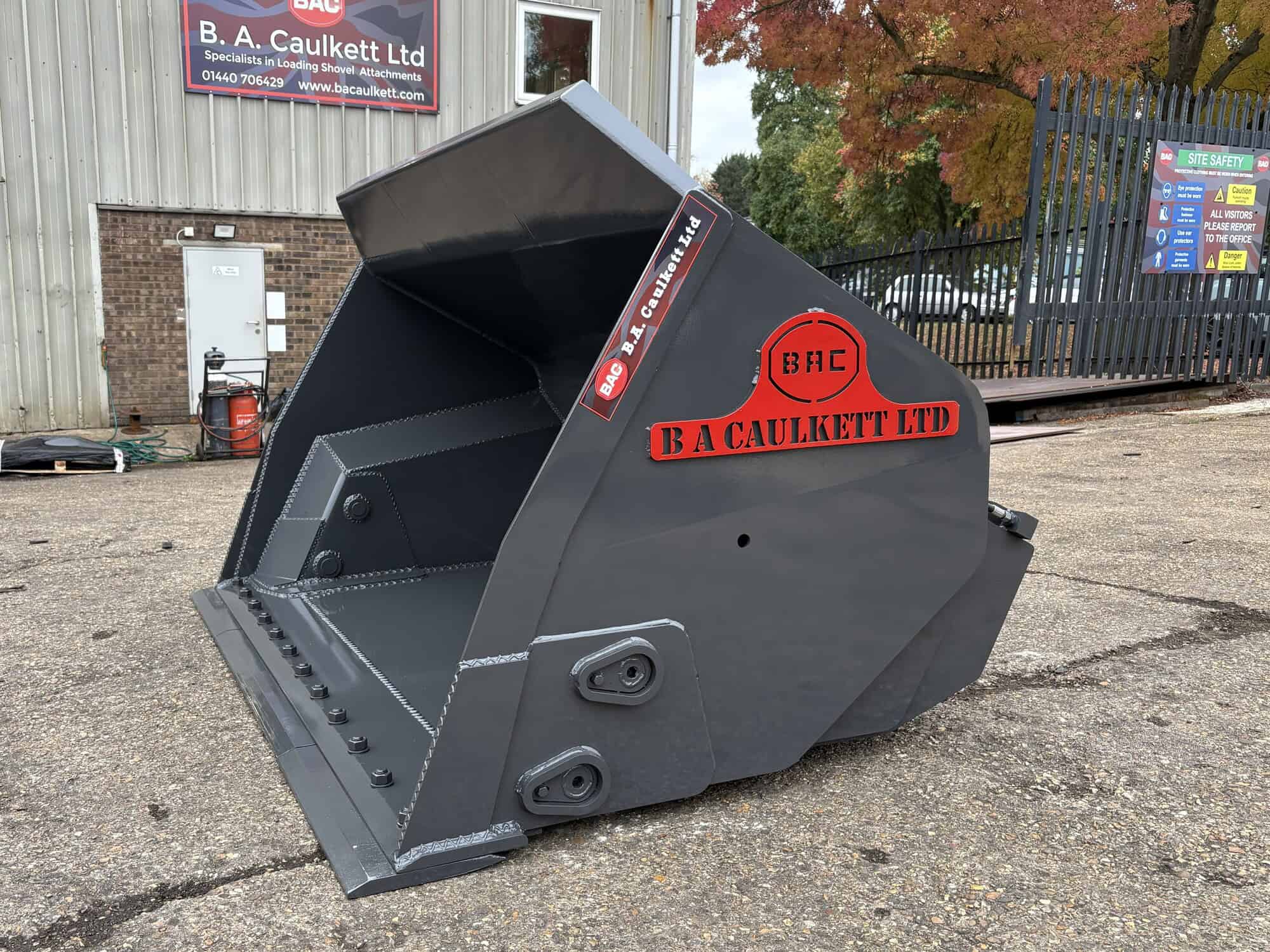

Visit the showroom, see the models and tour the factory
We are a manufacturer and primarily a factory environment so if you would like to visit the showroom its always best to contact us first. If you are interested we can then put all the required elements in place so that you can complete a factory tour if required.
Please call 01440 706429
The choice directly affects loading efficiency, cycle times, machine stability and overall productivity.
Key Technical Considerations
- Material being handled, such as grain, woodchip, compost, aggregates, manure, waste or snow
- Material density (kg/m³)
- Required loading height
- Required discharge distance
- Number of loading cycles per day
- Whether tipping over trailers, hoppers or feed mixers is required
- Machine operating environment, such as a farm, recycling yard, quarry or industrial site
Why does it matter?
High Tip Buckets maximise discharge height where additional clearance is required.
GP Buckets generally offer greater capacity and faster loading where additional tipping height is unnecessary.
Selecting the wrong bucket can result in reduced productivity and unnecessary wear on the loader.
Ensures the attachment is correctly matched to the required loading height, material and operating environment.
A bucket that is too large or too heavy can quickly exceed the machine’s design limits.
Key Technical Considerations
- Machine operating weight
- Rated operating load
- Tipping load
- Hydraulic lift capacity
- Breakout force
- Axle loading
- Counterweight specification
- Maximum lift height
- Centre of gravity with the bucket fully tipped
Why does it matter?
A High Tip Bucket places the load further forward during the tipping cycle than a GP Bucket.
The increased load centre can significantly affect machine stability, steering control and axle loading.
Correct sizing ensures safe operation while maximising the available payload.
Confirms the loader can safely lift, carry and tip the fully loaded bucket without exceeding its operating limits.
Unlike a GP Bucket, a High Tip Bucket requires an additional hydraulic function to operate its tipping mechanism.
Key Technical Considerations
- Hydraulic oil flow (L/min)
- Maximum operating pressure (bar)
- Auxiliary hydraulic services
- Double-acting hydraulic spool requirement
- Hose routing
- Ram size and stroke
- Hydraulic cylinder operating speed
- Cross-relief valve protection
- Hose burst protection, where applicable
Why does it matter?
Insufficient oil flow can result in slow tipping cycles.
Incorrect hydraulic pressure may prevent the bucket from completing its full tipping movement or place excessive strain on the hydraulic components.
Proper hydraulic matching improves productivity while protecting the cylinders, hoses and valves from premature failure.
Ensures the bucket tips smoothly, quickly and reliably without overloading the loader’s hydraulic system.
Bucket volume alone does not determine the maximum safe payload.
Key Technical Considerations
- Bucket capacity in litres or cubic metres (m³)
- Material density (kg/m³)
- Safe working load
- Heaped versus struck capacity
- Bucket width relative to the machine
- Material flow characteristics
- Centre of gravity during loading and tipping
Typical Material Densities
- Grain: approximately 700–800 kg/m³
- Woodchip: approximately 250–450 kg/m³
- Compost: approximately 500–800 kg/m³
- Sand: approximately 1,500–1,800 kg/m³
- Wet aggregate: over 2,000 kg/m³
Why does it matter?
A bucket suitable for woodchip may overload the same machine when filled with gravel or wet aggregate.
Correct capacity ensures the loader remains within its safe lifting and tipping limits.
Matching the bucket design to the material density maximises efficiency without compromising safety.
Prevents overloading by matching the bucket’s volume and payload to the density of the material being handled.
Buckets often operate in harsh environments where equipment failure and downtime can be expensive.
Key Technical Considerations
- Steel grade used throughout the bucket
- Wear plate thickness
- Cutting edge specification, including reversible or bolt-on options
- Reinforced floor and side walls
- Box-section strengthening
- Pin and bush material specification
- Greaseable pivot points
- Ram mounting design
- Torsional reinforcement
- Weld quality and fabrication standards
Why does it matter?
Higher-grade steels can reduce bucket weight without sacrificing structural strength.
Reinforced wear areas extend service life and reduce the frequency of repairs.
Better engineering reduces the risk of cracking, distortion and premature component failure.
Well-designed buckets can provide significantly lower lifetime ownership costs despite a higher initial purchase price.
Improves reliability, extends service life and reduces the total cost of owning and maintaining the bucket.
