

A high lift bucket is a very versatile loading shovel attachment, suitable for a wide range of applications, including grain loading. The attachments are commonly used across a number of industries, amongst which are agriculture and construction.
A high lift bucket is a type of bucket attachment that can be used on a wheel loader to increase the height and reach of the loader’s lifting capabilities. It is designed with a longer arm or boom that extends higher and farther forward than a standard bucket, allowing the operator to reach taller loads and dump materials into higher containers.
Typically, high lift buckets are used in situations where the wheel loader needs to lift and load materials onto high-sided trucks or containers, such as in mining, construction, and agricultural applications. With a high lift bucket, the loader can reach higher and dump the material without requiring the truck or container to be positioned at ground level.
To use a high lift bucket, the operator will first need to attach it to the loader’s lifting arms using the appropriate attachment mechanism. Once attached, the operator can use the loader’s controls to extend the boom and raise the bucket to the desired height. The operator can then manoeuvre the loader to the material to be loaded, scoop it up with the bucket, and then lift and dump it into the desired location.
The product can help to increase load time and efficiency and is a potentially invaluable resource in the arsenal of any company that regularly carries out loading.

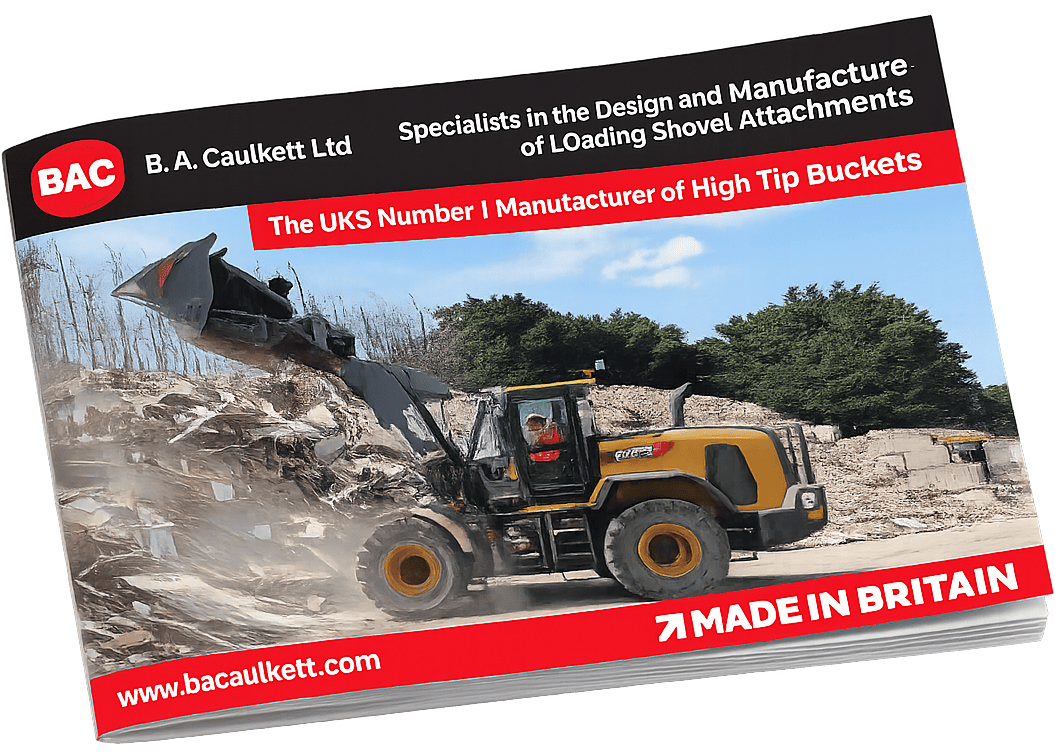
Increase Load Height, Decrease Load Time
As the name of the product suggests, a high lift bucket facilitates additional lifting height. As such, it can be used in conjunction with high sided vehicles, including walking floor trailers and hoppers. This is a crucial factor that can help a company to increase efficiency, productivity and, ultimately, profitability.
To further increase efficiency, we offer bespoke high lift buckets. Using the latest in CAD technology, we are able to design and manufacture a product that is tailored to the specific requirements of a customer. Our high tip buckets are available in capacities ranging from 1cm³ to 14cm³.
Built in England, Built to Last
Our range of high tip buckets are built in our purpose built factory in the East of England. Here, we have a team of highly skilled and experienced engineers, each one coded to BS4872. To ensure continuity of a project, each attachment is fabricated and manufactured start to finish in house by an individual engineer.
Our high lift buckets are made using only the highest quality materials, a factor that helps to ensure their longevity. The products are also fitted with replaceable wear pads that help to protect areas that are exposed to mechanical abrasion.
Furthermore, the products are equipped with bolt on heel plates and closing dampeners on the bucket frame. Combined, these measures help to further extend the life of the product.
Key Technical Considerations
- Loader operating weight
- Rated operating capacity (ROC)
- Static tipping load, both straight and articulated
- Hydraulic flow (L/min)
- Hydraulic pressure (bar)
- Loader linkage geometry
- Quick hitch type
Why does it matter?
The most important consideration is matching the high lift bucket to the loader’s capabilities.
A high lift bucket moves the load further forward and significantly higher than a standard bucket, increasing the leverage exerted on the loader.
A bucket that is too large can reduce machine stability, lifting performance and safe operating capacity.
Correctly matching the bucket to the machine maximises productivity while maintaining the loader manufacturer’s safe operating limits.
Key Technical Considerations
- Maximum hinge pin height
- Maximum discharge height
- Dump clearance
- Forward reach at full discharge
- Dump angle
- Loader size and linkage geometry
- Height of trailers, skips, hoppers or processing equipment
Why does it matter?
The available discharge height depends on both the high lift bucket design and the host machine.
Many high lift buckets provide approximately 800 mm to 1,500 mm of additional discharge height compared with a conventional bucket. However, the actual increase will vary according to the loader size, linkage geometry and bucket configuration.
The required discharge height should always be compared with the loading height of the trailers, skips, hoppers or processing equipment being used.
An insufficient discharge height may prevent the loader from filling high-sided equipment efficiently.
Selecting the correct lift height eliminates unnecessary double handling and improves loading cycle times.
Typical Bulk Densities
| Material | Approximate Density (kg/m³) |
|---|---|
| Woodchip | 180–350 |
| Compost | 450–700 |
| Grain | 700–850 |
| Sand | 1,500–1,700 |
| Gravel | 1,600–1,900 |
| Wet soil | 1,700–2,100 |
Capacity Calculation
Bucket Volume × Material Density ≤ Safe Lift Capacity
Why does it matter?
Bucket volume alone is not sufficient when selecting the correct attachment. The material’s bulk density determines the actual payload carried by the loader.
Two buckets of identical volume can carry vastly different payloads depending on the material being handled.
The selected bucket capacity must remain within the loader’s safe lifting and tipping limits throughout the entire lift and discharge cycle.
Correct capacity calculations prevent machine overloading, maintain stability, improve fuel efficiency and extend the service life of both the loader and bucket.
Key Technical Considerations
- Hydraulic oil flow (L/min)
- Operating pressure (bar)
- Auxiliary hydraulic availability
- Hose size and routing
- Hydraulic coupling compatibility
- Cylinder size and operating requirements
- Expected tipping and return cycle times
Potential Effects of Insufficient Hydraulic Performance
- Slow tipping and return cycles
- Reduced loading productivity
- Difficulty fully emptying sticky or compacted materials
- Insufficient cylinder force
- Increased strain and wear on the hydraulic system
Why does it matter?
High lift buckets rely on hydraulic cylinders to tip the load and return the bucket efficiently.
The bucket cylinders should always be matched to the loader’s available hydraulic oil flow and operating pressure.
A hydraulic system with insufficient flow or pressure can result in slow operation, incomplete bucket discharge and unnecessary stress on hydraulic components.
Correct hydraulic matching provides smoother operation, faster cycle times and reliable bucket performance.
Key Engineering Features
- High-strength structural steel construction
- Reinforced side plates
- Box-section top beam
- Heavy-duty pivot pins
- Replaceable pivot bushes
- Large-diameter hydraulic cylinders
- Hardened cutting edge
- Replaceable wear strips
- Reinforced floor and heel plates
- Greaseable pivot points
- Protected hydraulic hose routing
Why does it matter?
High lift buckets experience significantly greater structural forces than standard buckets because of the increased lifting height and forward load position.
For demanding applications such as waste recycling, biomass, aggregates and agriculture, reinforced construction helps the bucket withstand repeated loading, lifting and tipping forces.
Replaceable wear components allow high-wear areas to be maintained without replacing major sections of the bucket.
Investing in a well-engineered bucket reduces downtime, lowers maintenance costs and delivers a longer operational service life.
