BAC High Tip Bucket on JCB 435S Hopper Loading
Technical Specification
- Hardox Used on High impact / Wear Areas
- Powerful Rams for Smooth Tipping Operation
- Designed for Ease of Material Discharge


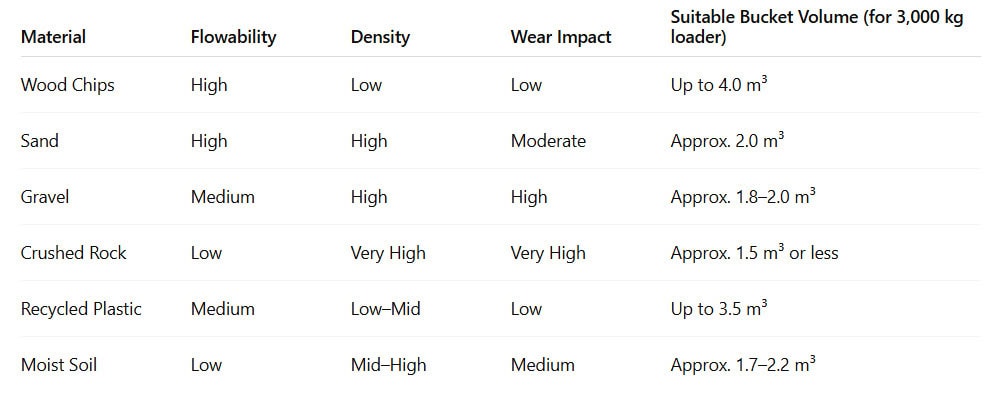
JCB Wheel Loader High Tip Bucket Selection
Understanding Weights, Densities, and Flow Characteristics of Materials for High Tip Buckets on Wheel Loaders
High tip buckets are integral attachments for wheel loaders used in handling and loading loose bulk materials into high-sided trucks, hoppers, or containers. Selecting the appropriate size of a high tip bucket depends not only on the capabilities of the wheel loader itself but significantly on the properties of the materials being handled. The weight, density, and flow characteristics of the material directly impact safety, efficiency, and operational suitability. The information below covers how these material characteristics influence high tip bucket use and sizing, using a range of common materials as examples.
1. Weight and Density of Materials
The weight of the material refers to the total mass of material that can be carried in a bucket, usually expressed in kilograms or tonnes. Density, more precisely bulk density in this context, is the mass of a material per unit volume, typically expressed in kilograms per cubic metre (kg/m³). Bulk density includes both the material itself and the air gaps between particles.
Below are average bulk density values of typical materials: Material Bulk Density (kg/m³)
- Wood chips 160 – 320
- Sand (dry) 1,440 – 1,600
- Gravel (loose) 1,520 – 1,680
- Crushed rock 1,600 – 2,000+
- Recycled plastic 150 – 800
- Topsoil (moist) 1,200 – 1,700
Note: These figures vary based on moisture content, particle size, compaction, and material composition.
2. Flow Characteristics
Flow characteristics describe how a material behaves when moved or loaded, which influences how easily it enters and exits the bucket, how it compacts, and how it can be dumped. These properties include:
Angle of repose: The steepest angle at which material can be piled without slumping. Materials like dry sand have low angles, while damp soil or irregularly shaped rock may have higher angles.
Cohesiveness: The tendency of material to stick together. Clay-rich soil and damp organic matter are more cohesive, whereas dry gravel or chips are less so.
Granulometry: The size and distribution of particles, affecting how easily material flows.
Moisture content: Affects both density and flow; damp sand is more cohesive and denser than dry sand.
Let’s examine a few materials in more depth.
3. Examples of Materials
Wood Chips
- Density: Low (160–320 kg/m³).
- Flow: Free-flowing but lightweight and bulky. They do not compact well and have a high angle of repose.
- Bucket Consideration: A larger volume bucket can be used because the material is lightweight. Spillage is minimal due to flowability.
Sand
- Density: High (1,440–1,600 kg/m³).
- Flow: Excellent flow, low cohesion, and low angle of repose. Can become compacted when damp.
- Bucket Consideration: High density means volume must be limited to avoid overloading. Easy to handle mechanically.
Gravel
- Density: Moderate to high (1,520–1,680 kg/m³).
- Flow: Granular but more irregular than sand, with slightly poorer flow characteristics.
- Bucket Consideration: Similar to sand in handling, but with more wear on bucket components due to abrasiveness.
Crushed Rock
- Density: Very high (1,600–2,000+ kg/m³).
- Flow: Poor flow due to angularity and size. Highly abrasive and compactable.
- Bucket Consideration: Small bucket volume required; wear protection necessary. Equipment stress is higher.
Recycled Plastic
- Density: Highly variable (150–800 kg/m³).
- Flow: Depends on the form — flakes, pellets, or shredded. Usually light and moderately free-flowing.
- Bucket Consideration: Bucket sizing depends on consistency. Lightweight forms allow larger volumes.
Soil (Topsoil/Loam)
- Density: Variable (1,200–1,700 kg/m³), affected by moisture.
- Flow: Moderately cohesive. Can clump and stick, especially when moist.
- Bucket Consideration: Bucket volume must consider compaction and potential sticking. May need liners or anti-stick coatings.
4. Determining Appropriate High Tip Bucket Size
When determining the appropriate bucket size for a wheel loader handling these materials, the following steps must be followed:
a) Understand Loader Specifications
Wheel loaders have a maximum rated payload (e.g., 3,000 kg), tipping load, and hydraulic lifting capability. These are non-negotiable safety thresholds.
b) Calculate Material Mass
Material mass = Volume of bucket × Bulk density of material
E.g., 2.5 m³ bucket with sand: 2.5 m³ × 1,500 kg/m³ = 3,750 kg → exceeds 3,000 kg rated payload → unsafe.
In this case, the bucket must be downsized to match the rated payload:
Maximum bucket volume = Payload / Bulk density = 3,000 kg / 1,500 kg/m³ = 2.0 m³
c) Consider Bucket Fill Factor
This accounts for how fully a bucket is filled. It ranges from 0.9 (loose material like chips) to 1.1 (dense, compacting materials like moist sand). Adjust volume accordingly.
d) Material Behaviour
Materials that are cohesive or sticky may reduce real-world bucket efficiency. Larger buckets might be used with lightweight materials like wood chips, while dense, sluggish materials demand smaller, reinforced buckets.
5. Safety Considerations
Using a bucket beyond the wheel loader’s rated capacity compromises:
- Stability: Overloaded buckets raise the centre of gravity and risk tipping.
- Braking Efficiency: Heavier loads affect stopping distances.
- Hydraulic System Load: Excess weight strains lifting mechanisms.
- Structural Integrity: Long-term overloading can damage frames and linkages.
Manufacturers often provide material density charts and corresponding safe bucket sizes for each model. It is critical to reference these alongside on-site testing, particularly for variable materials like recycled waste or wet soil.
6: Practical Application of Characteristics
Understanding the properties of materials — particularly their weight, density, and flow characteristics — is essential for selecting the correct high tip bucket size for a wheel loader. While light and fluffy materials allow for large buckets, dense or abrasive materials necessitate smaller, more robust options. Safety margins, fill factors, and real-world flow behaviour must always be factored in to ensure operational safety, equipment longevity, and loading efficiency. Engineers and operators must work together to assess these variables thoroughly before choosing a high tip bucket for any application.