

If you are in the market for a Premium High Loading Shovel Bucket, at B. A. Caulkett we are confident that we fulfill your requirements. We are a trusted supplier that offers a great selection of forklift buckets designed to be used across a range of applications. We offer bespoke design options, ensuring that you’re able to find a product that precisely fits your needs. Please continue reading for more information.
Who Are B. A. Caulkett?
We are an extremely experienced company that specialises in the design and manufacture of attachments for forklifts and loading shovels.
We are a family run business that is based in Suffolk in the East of England. We own our very own a purpose built facility where we carry out the in house design and manufacture of all of our products. As an industry leader, we employ cutting edge techniques and incorporate all up to date best practices.
What Industries Do You Cater For?
We design and manufacture products for a huge range of different industries and sectors, and supply some of the biggest names in construction and agriculture.
We offer a comprehensive range of buckets including clam buckets, general purpose buckets, sugar beat buckets and waste buckets.
We offer bespoke design options to our customers and will design your product around your need. Whichever industry you work in, let us know and we will advise you on the options we have available for you.

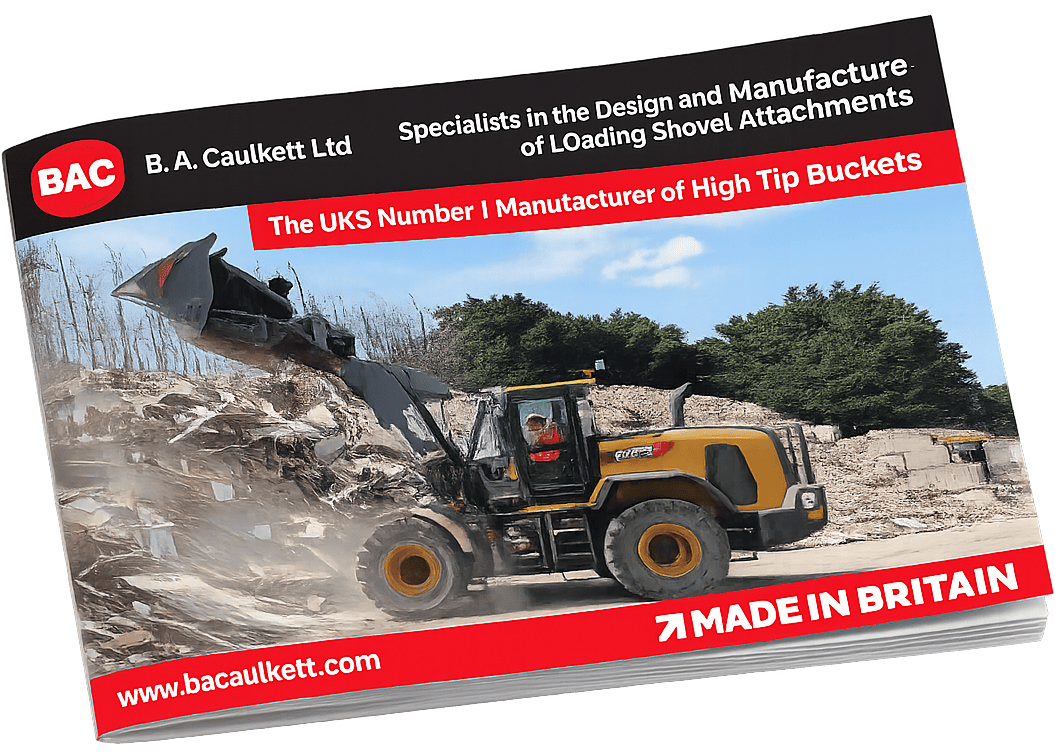
Are Your Products Compatible with a Range of Forklift Manufacturers?
Our products offer almost universal compatibility and can be used with a huge range of different makes and models of forklifts, loading shovels and telehandlers.
Please call 01440 706429
A premium high loading bucket should always be specified to suit the exact wheel loader model rather than simply the hitch type.
Key Technical Considerations
- Loading shovel make and model
- Machine operating weight
- Breakout force
- Hydraulic lifting capacity
- Full-turn tipping load
- Loader arm and linkage geometry
- Bucket capacity and dead weight
These factors influence the optimum bucket size for the machine. Selecting a bucket that is too large can reduce machine stability, increase fuel consumption and place unnecessary stress on the loader arms and linkage.
Conversely, an undersized bucket prevents the machine from achieving its maximum productivity. A correctly matched bucket allows the loader to operate safely while delivering the highest possible tonnes per hour.
Why does it matter?
- Maximises machine productivity.
- Prevents overloading and excessive component wear.
- Maintains safe operating characteristics.
Bucket capacity should be selected using the bulk density of the material rather than simply choosing the largest available bucket.
Key Technical Considerations
- Material type
- Average material bulk density
- Required bucket volume
- Loader safe working load
- Full-turn tipping load
- Bucket fill factor
- Target payload per loading cycle
Manufacturers will often calculate the recommended bucket volume based on the average material density and the loader’s safe working load, helping to achieve the optimum payload during every loading cycle.
Materials such as grain, biomass and woodchip have relatively low bulk densities and can therefore be handled using larger-capacity buckets. Aggregates, sand, wet compost and minerals require smaller buckets to keep the combined bucket and material weight within the machine’s rated lifting capacity.
Why does it matter?
- Achieves maximum payload efficiency.
- Prevents the machine from exceeding its safe lifting limits.
- Optimises loading cycle times.
Premium buckets are typically manufactured using high-strength structural steel combined with abrasion-resistant materials in the areas exposed to the greatest levels of wear.
Key Technical Considerations
- High-strength structural steel specification
- Abrasion-resistant wear steel
- Reinforced bucket floor
- Replaceable cutting edges
- Heel plates
- Side wear strips
- Replaceable wear liners
- Protection around high-wear loading areas
Reinforced floors, replaceable cutting edges, heel plates, side wear strips and wear liners can significantly extend the bucket’s service life.
The use of higher-strength steels can also allow the bucket structure to be lighter while maintaining its structural integrity. Reducing the bucket’s dead weight increases the payload that the machine can safely lift.
Why does it matter?
- Increases the bucket’s working lifespan.
- Reduces maintenance and repair costs.
- Improves available payload by reducing bucket dead weight.
Premium high loading buckets are designed with carefully engineered geometry to maximise both loading height and material retention throughout the loading cycle.
Key Technical Considerations
- Optimised bucket shell profile
- Extended floor design
- Side plate height
- Bucket opening and loading geometry
- Bucket centre of gravity
- Tipping angle
- Discharge height and reach
- Material carry-back characteristics
Features such as an optimised shell profile, extended floor, higher side plates and carefully positioned centre of gravity help improve bucket filling and reduce material spillage during lifting and transport.
The bucket’s tipping angle should also provide fast and complete discharge into trailers, hoppers and processing equipment while minimising material carry-back.
Why does it matter?
- Reduces material loss and spillage.
- Improves loading efficiency.
- Allows easier loading of taller trailers, hoppers and processing equipment.
High loading buckets experience significant forces during digging, crowding, lifting and repeated loading cycles. Premium buckets must therefore be engineered to distribute these forces throughout the complete structure.
Key Technical Considerations
- Reinforced hitch frame
- Boxed upper sections
- Heavy-duty torque tubes
- Structural gussets and stiffeners
- Strengthened floor sections
- Reinforced side walls
- Floor-to-backplate junction reinforcement
- High-stress weld design
Particular attention should be given to high-stress areas such as the hitch, side walls and floor-to-backplate junctions. These are the locations where fatigue cracking is most likely to occur when insufficient reinforcement is incorporated into the bucket design.
Why does it matter?
- Extends the bucket’s structural life.
- Reduces the likelihood of fatigue cracks.
- Provides greater reliability in demanding loading applications.
