

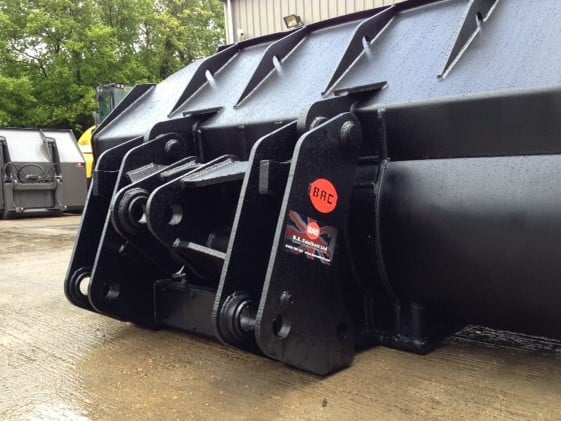
B. A. Caulkett manufacture euro quick hitch brackets to the highest standards using premium quality materials. Our brackets can be supplied to fit any make or model of loader or materials handler.
We have more than 30 years of experience in the design and manufacture of products for a range of applications and sectors, including agriculture and construction. The chance is that if a manufacturer has loading shovels capabilities we have built brackets, buckets and grabs to fit.
Heavy Duty Design
Our Euro quick hitch brackets are designed with durability and longevity in mind.
The products excel in the demanding environment of agriculture and construction.
They are long term investments that provides lasing service at a consistently high level.
Tailored Solutions
Our experience in the industry provides us with unique insights. As such, we understand that every company requires a solution that meets their individual needs. Tailored solutions can help to optimise efficiency and improve productivity.
Therefore, our quick hitch brackets are available to fit all makes and models of loader or materials handler with individually configured angles, widths and spacings.
Owing to their universal compatibility, our brackets can be used in conjunction with a comprehensive range of attachments including buckets, both regular and high loading; folding forks; pusher blades; silage forks; palette forks; and pipe and log grabs. They can also be specially designed to fit individual one off specialist attachments. For instance, perhaps a company has individual requirements pertaining to size, materials or operating characteristics.
Please call 01440 706429
Brackets, Buckets and Hitches All Made In Britain
B. A. Caulkett is a long established UK based, family run business. With more than 30 years’ experience of designing and manufacturing attachments for loading shovels for a wide variety of industries and applications. Our products are built to the highest quality standards using only premium material. All of our products are tested and retested to ensure that they deliver long term service to our customers.
Key Technical Considerations
- Loader make and model compatibility
- Euro carriage dimensions and tolerances
- Correct hook and locking pin positions
- Hydraulic or manual locking system compatibility
- Existing attachment mounting arrangement
Why does it matter?
A correctly matched bracket ensures secure engagement, minimises wear on the hitch interface and prevents excessive movement that could reduce lifting performance or create safety risks.
Provides safe attachment retention, reliable operation and maximum compatibility.
Key Technical Considerations
- High tensile structural steel grades
- Laser-cut or CNC-machined components
- Robotic or coded weld procedures
- Stress distribution around lifting points
- Corrosion-resistant paint or powder-coated finish
Why does it matter?
The hitch bracket experiences repeated high cyclic loading.
Premium materials and controlled manufacturing improve fatigue resistance, increase service life and reduce the likelihood of structural failure.
Delivers long-term durability and dependable performance in demanding applications.
Key Technical Considerations
- Safe Working Load (SWL)
- Maximum machine breakout force
- Dynamic loading factors
- Torsional loading during uneven operation
- Compliance with applicable engineering safety factors
Why does it matter?
An under-specified bracket may deform under heavy use.
An appropriately engineered bracket maintains structural integrity and protects both the loader and attachment.
Ensures safe lifting performance while protecting the machine and attachment.
Key Technical Considerations
- Accurate hook geometry
- Precision-machined pin locations
- Minimal manufacturing tolerances
- Full locking pin engagement
- Correct alignment of upper and lower hitch faces
Why does it matter?
Poorly manufactured brackets can create movement between the machine and attachment, accelerating wear, reducing operator confidence and increasing maintenance costs.
Maintains precise fitment, secure locking and long-term reliability.
Key Technical Considerations
- Inspect welds for cracks or fatigue
- Check locking pins for wear and full engagement
- Examine hook faces for deformation or excessive wear
- Lubricate moving locking mechanisms where applicable
- Check for corrosion, loose components and paint damage
Why does it matter?
Regular maintenance helps prevent unexpected downtime, maintains safe attachment retention and maximises the working life of both the bracket and the loader.
Extends service life while ensuring safe and reliable attachment operation.
