

Hi tip buckets are a type of loading shovel attachment. The attachments are suitable for a range of agricultural applications and can help a company to optimise their day to day operations.
In general, a “high tip bucket” is a type of bucket attachment for a loader or excavator that is designed to lift materials higher than a standard bucket. It usually has a higher back and a longer bottom than a regular bucket, allowing it to reach higher and dump material into taller containers or trucks.
The main operating characteristics of a hi tip bucket include:
- Height: A hi tip bucket is designed to lift materials higher than a standard bucket, typically up to around 4 meters (13 feet) or more. This allows it to load materials into high-sided trucks, containers, or hoppers.
- Capacity: The capacity of a high tip bucket can vary depending on the make and model, but it is generally similar to that of a standard bucket. High tip buckets are often available in a range of sizes to suit different machines and applications.
- Dump angle: The angle at which a high tip bucket can dump its load is often steeper than that of a standard bucket, allowing it to fully empty the material it is carrying into a container or truck.
- Durability: High tip buckets are typically made from heavy-duty materials such as reinforced steel to withstand the rigors of heavy use in demanding environments. BAC have 3 options. Ultra which provides high strength and lower weight, Extreme heavy duty for use in harsh operating environments and custom operating bespoke specification
- Control: High tip buckets are often equipped with advanced hydraulic controls that allow the operator to precisely control the height and angle of the bucket, making it easier to load and unload materials.
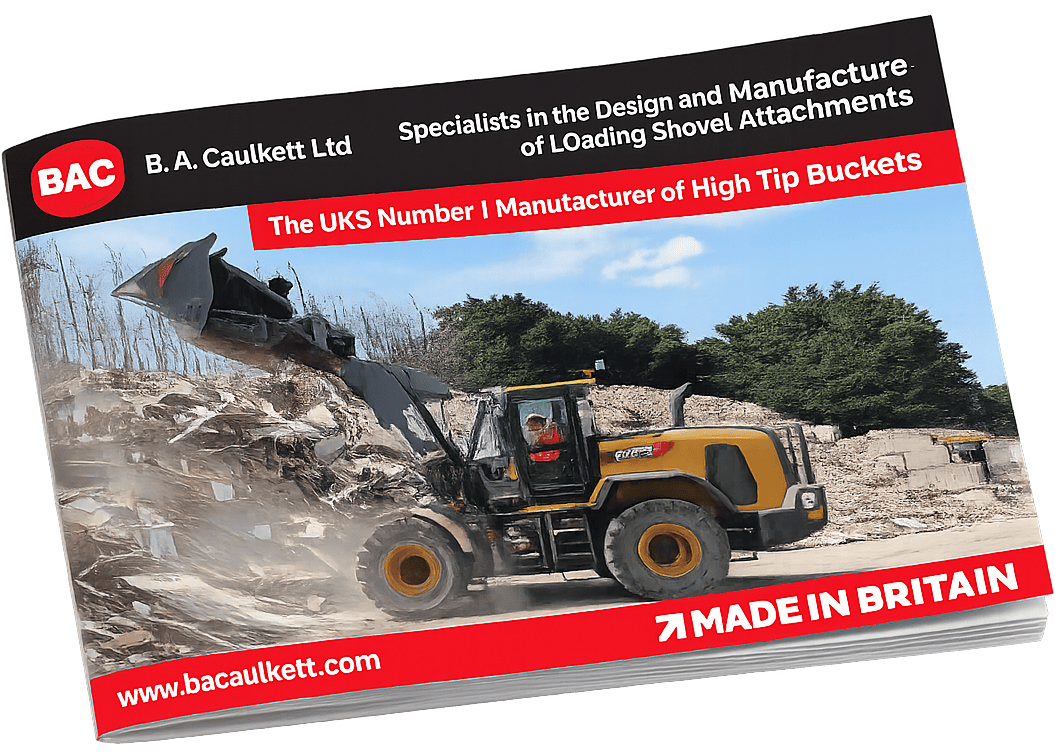
B. A. Caulkett produce a comprehensive range of high tip buckets, with the solutions manufactured to the specifications and requirements of a customer.

Suitable for use on a wide range of machines
Hi tip buckets can be used on a variety of machines that have compatible lifting mechanisms and hydraulic systems. Some of the most common types of machines that can be fitted with hi tip buckets include:
- Wheel loaders: Hi tip buckets can be attached to the front of wheel loaders to increase their reach and loading height. This is particularly useful for loading materials into high-sided trucks or containers.
- JCB is a British manufacturer of construction equipment, including wheel loaders. Their range of wheel loaders includes compact models for use in tight spaces as well as larger machines for heavy-duty applications
- Caterpillar is a global manufacturer of construction and mining equipment, including a range of wheel loaders
- Volvo is a Swedish manufacturer of construction equipment, including wheel loaders. Their machines are known for their efficiency and low fuel consumption, making them a popular choice for environmentally-conscious customers
- Other popular brands of wheel loaders in the UK include Komatsu, Case, Hitachi, Liebherr, Doosan, and Hyundai
- Skid steer loaders: Skid steer loaders can also be fitted with hi tip buckets, which can improve their versatility and allow them to handle a wider range of materials and tasks.
- Excavators: Hi tip buckets can be attached to the arm of excavators to extend their reach and enable them to load materials into higher containers or trucks.
- Telehandlers: Telehandlers are a type of lifting equipment that are often used in agriculture and construction. They can be fitted with hi tip buckets to increase their lifting height and capacity.
Overall, hi tip buckets can be used on a wide range of machines, depending on the specific needs of the application. It’s important to select a hi tip bucket that is compatible with the machine and the type of work it will be used for.
Hi Tip Buckets – Uses & Advantages
A hi tip bucket has a number of practical applications within the agriculture industry. The loading shovel attachment, for instance, is typically used for grain loading. The extra height permitted by the attachment makes it ideal for loading into high sided trailers, which are common in the agriculture industry and can significantly help to increase grain loading time.
About the Product
At B. A. Caulkett, our hi tip buckets are designed and manufactured to our customers’ exact specifications and requirements, and is made using the highest quality premium materials.
We offer the product with 1cm³ to 14cm³ capacity.
The product features a twin ram system, clear floor and quick hitch or direct mount fitment, as well as a trash guard and spill guard.
B. A. Caulkett hi buckets also come equipped with a bolt on reversible wear edge, bolt on heel plates and closing dampeners on the bucket frame. The product comes with all hoses and fittings.
Our tip buckets are fitted with hydraulic cross line relief valves to protect the hydraulic system on the products.
B. A. Caulkett – Made In Britain
B. A. Caulkett is a long established industry expert with more than 30 years’ experience in the design and manufacture of high quality loading shovel attachments for a variety of industries and applications. We are a UK based, family run business and create products to the exact requirements of a customers.
Operators want to maximise tonnes moved per hour while maintaining safe operation.
Key Technical Considerations
- Optimised pivot geometry allows material to discharge cleanly into taller trailers or hoppers without multiple repositioning movements
- Correct bucket capacity and weight distribution maintain machine balance throughout the tipping cycle
- Reduced rollback and re-handling improves loading efficiency
- Matching the bucket to the loader’s lift capacity ensures consistent performance without overloading the hydraulic system
Why does it matter?
Faster loading cycles.
Increased material throughput.
Reduced operator fatigue.
Lower fuel consumption per tonne handled.
Efficient bucket geometry increases productivity whilst maintaining machine stability and safe operation.
The largest bucket is not always the most productive. The ideal specification balances payload, structural strength and machine compatibility.
Key Technical Considerations
- Material density (grain, woodchip, compost, waste, biomass, etc.)
- Loader operating weight and rated tipping load
- Bucket shell thickness and reinforcement
- Overall attachment weight
- Wear package specification
The ideal bucket maximises legal and safe payload rather than simply offering the largest volume.
Why does it matter?
Higher productivity.
Better fuel efficiency.
Reduced tyre and axle loading.
Longer machine life.
Matching the bucket specification to the application delivers the highest productivity with the lowest operating costs.
Downtime is one of the largest operating costs for any loading operation.
Key Technical Considerations
- Heavy-duty greasable pivot pins and bushes
- Protected hydraulic cylinders
- Replaceable wear strips and cutting edges
- High-quality hydraulic hoses with protected routing
- Robust tipping frame designed to minimise flex
- Easy-access lubrication points
Premium designs often require significantly less maintenance over their working life.
Why does it matter?
Reduced servicing time.
Increased machine availability.
Longer service intervals.
Lower lifetime ownership costs.
Well-engineered wear components and service-friendly design maximise uptime and reduce maintenance expenditure.
Material remaining inside the bucket wastes time, reduces payload and can contaminate subsequent loads.
Key Technical Considerations
- Internal side profile
- Floor angle
- Radius design
- Tip angle
- Smooth internal surfaces
- Correct discharge trajectory
A well-designed bucket empties completely on every cycle, particularly when handling sticky materials.
Why does it matter?
Faster emptying.
More consistent payloads.
Less manual cleaning.
Reduced contamination between different materials.
Optimised bucket geometry promotes clean material discharge and maximises operational efficiency.
Incorrect compatibility can significantly reduce performance, increase wear and compromise safe operation.
Key Technical Considerations
- Hydraulic oil flow requirements
- Operating pressure
- Ram sizing
- Tipping speed
- Quick hitch geometry
- Pin centres and pin diameters
- Loader breakout force
- Maximum lift height
Correct integration ensures the bucket operates at its designed performance without overstressing the machine.
Why does it matter?
Smooth hydraulic operation.
Faster tipping cycles.
Reduced stress on loader arms and hydraulics.
Improved reliability and attachment longevity.
Correct hydraulic and hitch compatibility ensures maximum performance, safe operation and long-term reliability.
